LAD/Blog #14: Calhoun's Speech on the Compromise of 1850


Calhoun mentions in the beginning that slavery will end up separating the nation. Furthermore, he states that the two parties in America have failed to prevent this division. He also mentions that the southern states can no longer remain in the union because they feel as if their honor is being attacked. Moreover, he addresses the fact that the balance between the north and the south has been broken with the North gaining too much influence in government due to the larger population. Additionally, he discusses that expansion is occurring more in the north due to laws. Since more northern states were being added, northern influence in congress was also c increasing. Moreover, he mentions that the north is getting most of the benefits from taxes, and that import duties are negatively impacting the south.  He also mentions that more immigrants are moving to the north which also increases its effect on the House. Calhoun goes on to mention that the only way that unity is going to be preserved is if fairness is given to the south, and if an actual compromise is initiated to solve the issues at hand. He concludes with the notion that he has done his duty to try to preserve the nation and that he is now free from responsibility

Image result for calhoun

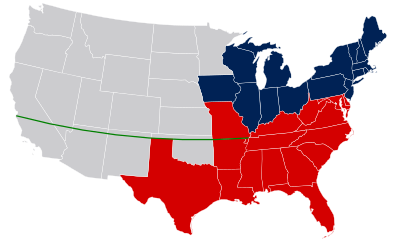
Image result for missouri compromise
The Missouri Compromise has a large effect on division among the US

Comments

Popular posts from this blog

LAD/Blog #8: Washington's Farewell Address

As America's first president, many actions taken by George Washington are considered modern precedents in modern America. In his address, he set the precedent for a 2-term presidency to prevent abuse of power. Washington warns of the formation of factions in American politics, citing that it will lead to excessive disunity.  He believed this would weaken the US as a people. He mentions the importances of taxes and funding the government appropriately, and that even though its resented it is still necessary. As he progresses, he preaches neutrality and isolationism, and not to get involved in the petty conflicts of Europe. Washington ends this speech with thanks to the American people, who enabled his success. Washington's Farewell address Another precedent Washington set was a farewell address, as President Barack Obama's address is pictured here.

LAD/Blog #19: The Dred Scott Decision

On March 6 1857, the Supreme court decided that any African Americans either slave or free were not American citizens and therefore could not pursue legal matters in court. Moreover, the court found that Congress did not have the ability to abolish slavery and that slave owners ownership on slaves was protected by the 5th amendment. Collectively, this came from Scott v. Sandford, where widowed Eliza Sanford refused to let Scott buy his freedom despite formerly living in a free state, causing a lawsuit. Justice Taney ruled that this case would not be considered and due to this, tensions furthered between North and South grew.  Dred Scott Decision Brown v. Board of education was very similar to this ruling

LAD/Blog #11: Monroe Doctrine

On December 2, 1823 President Monroe spoke to Congress explaining new and consequential Foreign policies under the title of the Monroe Doctrine. Through his new policies, 4 major aspects were addressed.  First, Monroe proclaimed that the U.S. would not interfere with  European affairs and conflicts. As he continued, he further exemplified his isolationist and neutral foreign policy by stating that he would not interfere with pre-existing European colonies, however his third point restricted any European nations from colonizing in the Western Hemisphere from this point forward. As Monroe addressed his final point, he subtly stated that he would protect nations if they were colonized by European powers. The Doctrine was originally going to be a joint declaration with Britain, however Adams appealed to American nationalism and it became a solely U.S. affair. Because of this, many European nations did not recognize the Monroe Doctrine, however America still had the support of Br...